The Power of Clarity in Leadership Effectiveness 2026

Table of Contents
The Power of Clarity in Leadership Effectiveness
In many organizations, leadership problems are often blamed on lack of effort, weak motivation, or insufficient talent. But in reality, most leadership failures stem from one root issue: lack of clarity.
When clarity is missing, even strong teams struggle. When clarity exists, average teams perform exceptionally.
Effective leadership begins with clear direction—not pressure.
🔹 Unclear Leadership Creates Confusion and Delay
When leaders are unclear, teams hesitate.
Organizations without clarity often face:
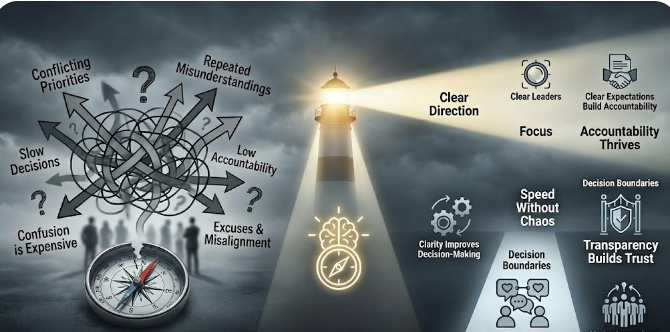
Conflicting priorities
Repeated misunderstandings
Slow decision-making
Low accountability
Employees waste energy guessing expectations instead of executing tasks. Meetings multiply. Decisions stall. Progress slows—not because people are incapable, but because direction is unclear.
Confusion is expensive.
Clarity is efficient.
🔹 Clear Leaders Reduce Noise and Increase Focus
Clarity simplifies complexity.
Clear leaders communicate:
What matters most
What success looks like
Who owns what
What comes next
This focus removes distractions. Teams align around shared goals instead of personal interpretations. Execution becomes faster—not rushed, but precise.
Focus is not about doing more.
It is about doing the right things consistently.

Why Clarity Matters More Than Authority in Leadership
🔹 Clear Expectations Build Accountability
Accountability fails when expectations are vague.
Clear leadership defines:
- Roles and responsibilities
- Performance standards
- Decision boundaries
- Ownership of outcomes
When expectations are visible, accountability becomes natural. Feedback feels objective, not personal. Performance improves without conflict.
People cannot meet expectations they do not understand.
🔹 Clarity Eliminates Excuses and Misalignment
Unclear expectations create room for excuses.
When clarity is missing:
- Responsibility shifts between people
- Mistakes are justified instead of corrected
- Performance issues become personal debates
- Teams blame circumstances instead of processes
Clarity removes ambiguity. Everyone knows what they own and what they are measured against. This shifts conversations from blame to improvement.
Accountability thrives where ambiguity ends.
🔹 Clarity Improves Decision-Making Across Teams
Decision-making slows when authority is centralized.
Clear leaders distribute clarity—not control.
They:
- Define decision rules
- Empower teams within boundaries
- Reduce unnecessary approvals
- Encourage ownership
As a result, decisions move faster without sacrificing quality. Leaders focus on strategy while teams handle execution confidently.
Clarity unlocks speed without chaos.

🔹 Decision Boundaries Reduce Risk and Delay
Without boundaries, teams hesitate.
Clear leadership establishes:
- What decisions teams can make independently
- When escalation is required
- Which risks are acceptable
- How outcomes will be reviewed
This removes hesitation and over-approval. Teams act confidently, knowing where limits exist. Risk is managed—not avoided.
Speed improves when fear is removed.
🔹 Clear Communication Protects Team Morale
Ambiguity creates stress.
When communication lacks clarity:
- Rumors spread
- Trust weakens
- Motivation declines
- Engagement drops
Clear communication reduces anxiety. Teams feel informed and respected. Even difficult decisions are accepted more easily when explained clearly.
Transparency builds trust.
Silence destroys it.
🔹 Clarity Prevents Emotional Reactions
Unclear communication invites assumptions.
When leaders communicate clearly:
- Fewer misunderstandings occur
- Emotional overreactions decrease
- Conflicts resolve faster
- Teams stay focused under pressure
Clarity keeps discussions factual instead of emotional. This protects morale and preserves relationships during challenging moments.
Clear words prevent unnecessary damage.
Why Clarity Strengthens Organizational Culture
🔹 Clarity Aligns Behavior With Values
Values mean nothing without clarity.
Clear leaders translate values into:
Daily behaviors
Decision criteria
Performance standards
Conflict resolution guidelines
This alignment ensures culture is lived—not advertised. Employees understand how values apply in real situations, not just presentations.
Culture grows where clarity exists.
🔹 Clarity Reduces Dependence on Individual Leaders
Organizations that rely on personal interpretation are fragile.
Clear systems ensure:
Knowledge is shared
Processes are documented
Decisions are consistent
Performance is repeatable
When clarity is embedded, organizations remain stable—even during leadership changes. Progress does not pause when one person leaves.
Clarity creates continuity.
🔗 External Resources and References
External Resource (DoFollow):
Internal Link: Factors That Made the UAE the Best Place for Investments
Conclusion
Leadership is not about control.
It is about direction.
Pressure may create movement.
Clarity creates progress.
Leaders who prioritize clarity build stronger teams, faster execution, and healthier cultures. They reduce friction, protect morale, and enable sustainable performance.
In the long run, clarity outperforms authority—because people perform best when they know exactly where they are going and why. 🧠🧭