Corporate Advisory Services UAE | Issue Consulting

Making an important business decision requires more than experience or intuition. Company owners, executives, shareholders, and investors must consider financial performance, market conditions, operational capabilities, corporate regulations, risks, and long-term objectives before choosing the right course of action.
Professional corporate advisory services provide organizations with the strategic, financial, and operational expertise required to evaluate complex situations and make informed decisions.
Whether your company is preparing for expansion, considering an acquisition, facing financial pressure, reviewing its governance structure, or developing a transformation strategy, professional advisors can help you assess your options and build a practical action plan.
At Issue Business Consulting, we provide tailored corporate advisory solutions for startups, SMEs, established companies, investors, and international organizations operating across the UAE.
Our approach begins with understanding your company’s current position, identifying the factors affecting its performance, and developing practical recommendations that support sustainable growth.
What Are Corporate Advisory Services?
Corporate advisory services are specialized consulting solutions that assist companies with strategic, financial, organizational, regulatory, investment, and transaction-related decisions.
A corporate advisor works with business owners, shareholders, directors, and senior management to understand the company’s objectives, challenges, resources, and risk exposure.
The advisor then reviews the relevant business information, assesses possible opportunities and risks, and develops recommendations aligned with the company’s commercial interests.
Depending on the organization’s requirements, corporate advisory services may include:
- Corporate strategy development.
- Financial performance analysis.
- Business valuation.
- Investment feasibility assessment.
- Company restructuring.
- Corporate governance development.
- Mergers and acquisitions support.
- Operational improvement.
- Risk management.
- Business transformation.
- Market-entry planning.
- Funding and capital structure assessment.
- Shareholder and organizational planning.
- Regulatory and corporate compliance support.
The purpose of corporate advisory is not simply to produce a report. Effective advisory support should explain what the company needs to do, why the recommended action is appropriate, and how it can be implemented.
Companies requiring broader support can also explore Issue’s business consultant services in the UAE for assistance with planning, operations, compliance, and business growth.
Why Are Corporate Advisory Services Important?
Major corporate decisions usually affect several areas of a company simultaneously.
For example, entering a new market may require changes to the company’s legal structure, financial plan, licensing arrangements, staffing requirements, technology, contracts, and management responsibilities.
Similarly, acquiring another company may appear financially attractive but create significant operational, regulatory, or cultural difficulties after the transaction is completed.
Without a coordinated advisory process, management may evaluate only one part of the decision and overlook other important consequences.
Professional business advisory consulting services help companies understand the wider commercial impact of their decisions before committing significant capital or resources.
A company may require corporate advisory assistance when it is:
- Experiencing declining profits.
- Facing cash-flow pressure.
- Preparing to enter the UAE market.
- Launching a new business division.
- Considering external investment.
- Preparing for a merger or acquisition.
- Reviewing shareholder responsibilities.
- Restructuring departments.
- Preparing the company for sale.
- Seeking to improve corporate governance.
- Managing rapid growth.
- Developing a digital transformation strategy.
- Responding to regulatory changes.
- Reviewing its long-term strategic direction.
The right advisory support allows management to replace assumptions with structured analysis and practical recommendations.
Corporate Advisory Services in the UAE
The UAE provides local and international businesses with access to a competitive, internationally connected, and investor-focused commercial environment.
However, companies must still understand the regulations, licensing requirements, tax obligations, corporate structures, employment rules, and sector-specific requirements that apply to their operations.
Mainland companies are generally governed by Federal Decree-Law No. 32 of 2021 on Commercial Companies, subject to applicable exemptions and industry-specific requirements. Companies can review further information through the official UAE Government guidance on mainland company regulations.
The requirements that apply to a company can depend on several factors, including:
- The company’s legal form.
- Its licensed business activities.
- The emirate in which it operates.
- Whether it is established on the mainland or in a free zone.
- The company’s ownership structure.
- Its industry and regulatory authority.
- Its customers and geographical markets.
Corporate advisors help management understand the commercial implications of these requirements and coordinate decisions with qualified legal, accounting, tax, and regulatory professionals where necessary.
This support is particularly important for international businesses that may be unfamiliar with the differences between mainland jurisdictions, free zones, regulated industries, and available corporate structures.
Companies preparing to establish a new entity can learn more through Issue’s guide to business registration in the UAE.
Types of Corporate Advisory Services
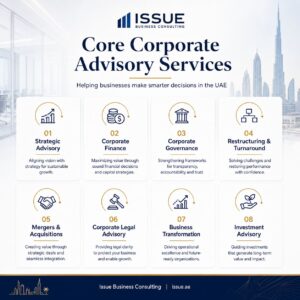
Corporate advisory covers several interconnected business areas. The appropriate combination of services depends on the company’s objectives, financial position, ownership structure, industry, and stage of development.
The following are among the main corporate advisory services available to UAE businesses.
Strategic Corporate Advisory Services
Strategic corporate advisory services help owners and executives define the future direction of their organizations.
A corporate strategy should explain where the company wants to go, which customers and markets it intends to serve, how it will compete, and which capabilities it needs to develop.
Without a clear strategy, businesses may pursue too many opportunities at the same time or invest resources in activities that do not support their long-term objectives.
Strategic corporate advisory services may include:
- Reviewing the existing business strategy.
- Analyzing market opportunities.
- Evaluating the company’s competitive position.
- Defining short- and long-term objectives.
- Identifying priority products and services.
- Reviewing revenue streams.
- Developing market-entry strategies.
- Evaluating expansion opportunities.
- Establishing performance indicators.
- Developing implementation plans.
- Allocating resources between departments.
- Monitoring strategic progress.
The advisory process should convert broad ambitions into specific, measurable, and achievable actions.
For example, a company that wants to increase revenue may need more than additional advertising. It may also need to improve its pricing, sales process, service delivery, customer retention, financial controls, and management structure.
Through strategic corporate advisory services, management can identify the initiatives most likely to deliver sustainable commercial results.
Business Advisory Consulting Services
Business advisory consulting services examine the overall direction and performance of an organization.
Unlike a narrowly focused consulting assignment, business advisory may review several connected areas to determine why the company is not achieving its expected results.
The advisory team may evaluate:
- The company’s business model.
- Products and services.
- Customer segments.
- Sales performance.
- Pricing strategy.
- Operational processes.
- Management structure.
- Financial results.
- Employee responsibilities.
- Internal reporting.
- Customer experience.
- Competitive positioning.
This wider assessment helps management distinguish between the visible symptoms of a problem and its actual cause.
For example, declining sales may not result from insufficient marketing. The underlying problem could involve pricing, product positioning, sales follow-up, customer service, or changes in market demand.
Professional business advisors identify the real issue before recommending a solution.
Corporate Finance Advisory Services
Financial decisions influence nearly every part of a business.
Corporate finance advisory services help organizations understand their financial position and evaluate the consequences of major commercial decisions.
Corporate finance advisory may include:
- Financial statement analysis.
- Cash-flow forecasting.
- Budget preparation.
- Profitability analysis.
- Working capital assessment.
- Cost structure review.
- Capital requirement planning.
- Debt assessment.
- Funding strategy development.
- Investment analysis.
- Business valuation.
- Financial modelling.
- Transaction preparation.
A company may report accounting profits while continuing to experience cash-flow difficulties.
This can happen when customers take too long to pay, inventory levels are too high, expenses are poorly controlled, or the company has unsuitable financing arrangements.
A corporate finance advisor examines the factors affecting financial performance and develops recommendations that support stability and growth.
The objective is not simply to reduce expenses. It is to improve how the company plans, allocates, monitors, and uses its financial resources.
Companies should also consider their UAE corporate tax obligations when preparing financial plans. The official UAE Government provides information about the current framework through its corporate tax guidance.
Company Restructuring Advisory Services
A company’s existing structure may no longer support its objectives as the organization grows or market conditions change.
Company restructuring advisory services help organizations redesign their financial, operational, legal, or organizational arrangements.
Restructuring may be required when a company is:
- Experiencing persistent financial pressure.
- Managing excessive operating costs.
- Facing declining profitability.
- Expanding into new markets.
- Separating different business activities.
- Preparing for external investment.
- Reviewing shareholder arrangements.
- Managing a leadership transition.
- Preparing for a sale or acquisition.
- Responding to changes in customer demand.
- Attempting to improve operational efficiency.
The restructuring process may involve:
- Reviewing the corporate structure.
- Evaluating business units.
- Redesigning departments.
- Clarifying management responsibilities.
- Reducing duplicated activities.
- Improving reporting lines.
- Reviewing financial obligations.
- Restructuring debt.
- Selling non-core assets.
- Developing a turnaround plan.
- Monitoring implementation.
Restructuring should not be viewed only as a response to business failure.
Successful and growing companies may also restructure to improve accountability, attract investment, introduce new leadership, separate business divisions, or prepare for expansion.
The UAE Financial and Bankruptcy Law provides a framework for addressing financial distress through applicable restructuring and bankruptcy mechanisms. Companies facing serious financial difficulties should review the official UAE Government guidance on bankruptcy and financial restructuring and seek qualified professional advice.
The purpose of company restructuring advisory services is to create a company structure that is more closely aligned with the organization’s current circumstances and future objectives.
Corporate Governance Advisory Services
Corporate governance determines how a company is directed, controlled, and held accountable.
A clear governance framework helps shareholders, directors, executives, and managers understand their responsibilities and decision-making authority.
Corporate governance advisory services may include:
- Reviewing board responsibilities.
- Defining management authority.
- Establishing board committees.
- Creating delegation frameworks.
- Reviewing shareholder rights.
- Developing conflict-of-interest policies.
- Improving internal controls.
- Establishing reporting procedures.
- Developing risk management frameworks.
- Reviewing approval processes.
- Improving financial oversight.
- Supporting board effectiveness.
Strong governance is particularly important for:
- Family-owned companies.
- Businesses with multiple shareholders.
- Regulated organizations.
- Rapidly growing companies.
- Businesses preparing to attract investors.
- Companies planning a merger or sale.
- Organizations experiencing leadership succession.
Without clear governance, decisions may be delayed, responsibilities may overlap, and important actions may be taken without the appropriate information or approval.
Corporate governance does not mean creating unnecessary procedures. It means developing a practical system that supports efficient, transparent, and responsible decision-making.
Mergers and Acquisitions Advisory
A merger or acquisition can give a company access to new customers, markets, technologies, employees, assets, and revenue opportunities.
However, transactions may also create significant financial, legal, operational, and integration risks.
Professional mergers and acquisitions advisory helps buyers, sellers, shareholders, and investors evaluate and execute corporate transactions.
M&A advisory may include:
- Defining transaction objectives.
- Identifying potential acquisition targets.
- Identifying potential buyers.
- Conducting initial business assessments.
- Coordinating due diligence.
- Preparing business valuations.
- Reviewing financial performance.
- Evaluating transaction structures.
- Supporting negotiations.
- Identifying transaction risks.
- Coordinating professional advisors.
- Preparing integration plans.
- Monitoring post-transaction performance.
An acquisition should not be evaluated only according to the purchase price.
Management must also consider whether the target company is strategically suitable, whether its financial performance is sustainable, and whether the two organizations can be integrated successfully.
Effective mergers and acquisitions advisory provides an objective perspective that helps decision-makers understand both the potential value and possible risks of a transaction.
Due Diligence Before an Acquisition
Due diligence is one of the most important stages of a corporate transaction.
Depending on the nature of the deal, the process may review:
- Historical financial performance.
- Assets and liabilities.
- Customer and supplier relationships.
- Contracts and legal commitments.
- Tax obligations.
- Employee arrangements.
- Intellectual property.
- Licenses and regulatory approvals.
- Technology and data.
- Operational processes.
- Pending disputes.
- Commercial forecasts.
The findings can affect the proposed price, transaction structure, contractual protections, or the decision to proceed with the acquisition.
Post-Merger Integration
Completing the transaction is only the beginning.
After an acquisition or merger, the companies may need to integrate:
- Employees and leadership teams.
- Financial systems.
- Technology platforms.
- Policies and procedures.
- Customer databases.
- Brands and marketing.
- Supplier relationships.
- Offices and operational facilities.
- Corporate cultures.
Planning integration before the transaction is completed can reduce disruption and protect the expected value of the deal.
Corporate Legal Advisory Services
Corporate decisions frequently involve contracts, licenses, shareholder agreements, regulatory obligations, employment relationships, and company documentation.
Corporate legal advisory services help organizations recognize the legal considerations associated with their commercial decisions and coordinate with appropriately qualified professionals.
Depending on the engagement, corporate legal advisory may involve:
- Reviewing the proposed company structure.
- Identifying regulatory requirements.
- Coordinating contract reviews.
- Reviewing corporate documents.
- Supporting shareholder arrangements.
- Identifying compliance risks.
- Coordinating transaction documentation.
- Supporting restructuring projects.
- Reviewing internal policies.
- Coordinating with qualified legal professionals.
Corporate legal advice should be connected to the company’s wider commercial strategy.
A structure that is legally available may not always be the most financially or operationally suitable option. Similarly, a commercially attractive proposal may create contractual or regulatory risks.
Integrated advisory support helps management balance legal requirements with strategic and commercial objectives.
Business Transformation Advisory Services
Companies must continuously respond to changes in technology, customer expectations, competition, regulations, and market conditions.
Business transformation advisory services help organizations redesign how they operate and deliver value.
Transformation initiatives may include:
- Introducing digital systems.
- Automating manual processes.
- Redesigning customer journeys.
- Improving data collection.
- Developing management dashboards.
- Restructuring departments.
- Creating new service-delivery models.
- Improving communication between teams.
- Developing performance management systems.
- Reducing operational delays.
- Improving customer service.
- Introducing new products or services.
A successful transformation project should begin with a clearly defined business problem.
Technology should not be introduced simply because it is new. New systems should improve efficiency, reduce costs, provide better information, or enhance the customer experience.
A business transformation plan should define:
- The current operating model.
- The desired future model.
- The changes required.
- The departments involved.
- The necessary budget.
- The implementation timeline.
- Potential risks.
- Responsible employees.
- Performance indicators.
- Review procedures.
Effective transformation requires more than technical systems. It also requires leadership support, employee engagement, appropriate training, and clear accountability.
Investment Advisory Corporate Services
Companies may consider investments in new markets, business divisions, partnerships, technologies, properties, assets, or other organizations.
Investment advisory corporate services help management evaluate whether a proposed investment supports the company’s objectives and financial capacity.
Investment advisory may include:
- Market opportunity assessment.
- Commercial feasibility analysis.
- Financial modelling.
- Return analysis.
- Risk assessment.
- Investment structure evaluation.
- Competitor analysis.
- Regulatory review.
- Funding requirement assessment.
- Scenario planning.
- Exit strategy development.
- Implementation planning.
A high projected return does not automatically make an investment suitable.
Management should also consider:
- The amount of capital required.
- The potential downside risk.
- The expected investment period.
- Market conditions.
- Regulatory requirements.
- The company’s implementation capabilities.
- The effect on existing operations.
- The expected exit options.
Investment advisory helps decision-makers evaluate opportunities objectively rather than relying only on optimistic projections.
Entrepreneurs assessing a new opportunity may also benefit from Issue’s startup advisory services in the UAE.
Professional Corporate Consulting for Business Growth
Growth creates opportunities, but it can also expose weaknesses within a company.
As a business expands, it may require stronger systems, clearer responsibilities, additional management capabilities, improved financial reporting, and better internal controls.
Professional corporate consulting supports growth by helping companies build structures that can continue operating effectively at a larger scale.
Advisory support can help a growing company:
- Prioritize expansion opportunities.
- Improve financial visibility.
- Develop scalable processes.
- Reduce dependence on individual employees.
- Improve management reporting.
- Strengthen internal controls.
- Review staffing requirements.
- Establish performance indicators.
- Prepare for external funding.
- Develop risk management procedures.
- Improve corporate governance.
- Maintain customer service standards.
Sustainable growth is not measured only by higher revenue.
A company must also maintain profitability, cash flow, service quality, employee performance, and operational control as it becomes larger.
When Should a Company Hire a Corporate Advisor?

Companies should ideally seek professional advice before a difficult situation becomes an urgent crisis.
Several signs may indicate that corporate advisory support is required.
Financial Performance Is Declining
Falling margins, inconsistent cash flow, increasing debt, or uncontrolled expenses may require a detailed financial and operational assessment.
Management Information Is Incomplete
Management cannot make reliable decisions when reports are delayed, inaccurate, or inconsistent.
An advisor can help determine which information decision-makers require and how it should be collected, reviewed, and presented.
The Company Is Preparing for Expansion
Expansion may require additional funding, licenses, employees, systems, contracts, facilities, and management capabilities.
An advisor can assess whether the business is ready and identify the changes required before expansion begins.
Shareholders Disagree About the Company’s Direction
Differences between shareholders can delay important decisions and create uncertainty for management.
Governance and strategic advisory can help clarify responsibilities, decision-making procedures, and long-term objectives.
The Company Is Considering a Major Transaction
Acquisitions, mergers, joint ventures, external investments, and company sales require careful preparation and objective analysis.
Operational Problems Continue to Reappear
Repeated delays, duplicated work, customer complaints, and unclear responsibilities may indicate that the existing operating model requires restructuring.
The Business Is Growing Too Quickly
Rapid growth can place pressure on cash flow, employees, technology, customer service, and management systems.
Corporate advisors help companies strengthen their internal foundations before these pressures affect performance.
The Corporate Advisory Process
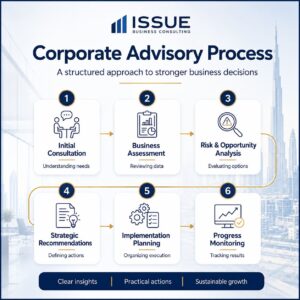
A professional corporate advisory engagement normally follows a structured process.
1. Initial Consultation
The process begins with a discussion about the company’s current situation, objectives, challenges, and expectations.
This consultation helps define the primary issue and determine the required scope of work.
2. Business Assessment
The advisor reviews the information relevant to the engagement.
This may include:
- Financial statements.
- Budgets and forecasts.
- Business plans.
- Corporate documents.
- Company licenses.
- Shareholder agreements.
- Organizational charts.
- Operational reports.
- Contracts.
- Internal policies.
- Management reports.
- Sales and customer information.
The depth of the assessment will depend on the type and complexity of the project.
3. Identifying Risks and Opportunities
The advisor evaluates the factors affecting the company’s performance or proposed decision.
This stage helps separate symptoms from underlying causes.
For example, low profitability may result from pricing, operational inefficiency, financing costs, customer concentration, weak cost controls, or an unsuitable business model.
4. Developing Recommendations
After completing the assessment, the advisor develops practical recommendations.
Each recommendation should explain:
- The proposed action.
- The reason for the action.
- Expected benefits.
- Potential risks.
- Required resources.
- Responsible parties.
- Implementation timeline.
- Performance measurements.
5. Implementation Planning
A recommendation creates value only when it can be implemented.
The implementation plan should divide the work into clear stages and assign responsibility for each action.
6. Progress Monitoring
Performance indicators help management determine whether the plan is delivering the expected results.
Regular reviews allow the company to respond to new information and modify the strategy when necessary.
How to Choose a Corporate Advisory Firm
Selecting the right corporate advisor is an important business decision.
Companies should evaluate more than a consultant’s presentation or list of services.
Relevant Experience
The advisor should understand the type of challenge your company is facing, whether it involves strategy, finance, governance, restructuring, transactions, investment, or transformation.
Knowledge of the UAE Business Environment
Companies operating in the UAE may need to consider federal legislation, local authorities, free-zone regulations, tax requirements, and sector-specific obligations.
Customized Recommendations
Reliable corporate advisory services should be based on the company’s actual position rather than a pre-designed package.
Multidisciplinary Perspective
Corporate decisions frequently involve strategic, financial, operational, regulatory, and organizational considerations at the same time.
The advisor should be able to examine how these areas affect one another.
Clear Scope and Deliverables
Before the engagement begins, the company should understand:
- What will be reviewed.
- Which services will be provided.
- What information will be required.
- Which deliverables will be produced.
- Who will be responsible.
- How long the project is expected to take.
- How progress will be evaluated.
Confidentiality
The advisory process may involve sensitive financial information, ownership arrangements, commercial plans, employee information, or internal business difficulties.
Confidential handling of this information is essential.
Implementation Capability
A report may explain what the company should do, but implementation determines whether the recommendations produce results.
Companies should look for advisors who can provide practical implementation and follow-up support.
Why Choose Issue for Corporate Advisory Services?
Issue Business Consulting provides integrated support for entrepreneurs, SMEs, established businesses, and international investors operating in the UAE.
Our approach to corporate advisory services begins with understanding the company rather than recommending a standard solution.
Extensive UAE Market Experience
Our team understands the practical challenges companies may encounter when establishing, operating, restructuring, or expanding in the UAE.
Customized Corporate Solutions
Every company has different objectives, resources, shareholders, and commercial circumstances.
We develop recommendations around the specific needs of each organization.
Integrated Advisory Support
Our services connect strategic planning with financial, operational, regulatory, organizational, and investment considerations.
Practical Recommendations
We focus on recommendations that can be implemented within the company’s real operating environment and available resources.
Support During Implementation
Issue can support management beyond the initial assessment by helping coordinate implementation, monitor progress, and respond to emerging challenges.
Support for New and Established Companies
Whether you are launching a new company or improving an established organization, Issue can provide advisory support appropriate to your stage of development.
Companies still evaluating the establishment process can also review the stages of establishing a company in Dubai and the main factors affecting the cost of establishing a company.
Frequently Asked Questions
What Is the Purpose of Corporate Advisory Services?
Corporate advisory services help companies make informed decisions related to strategy, finance, governance, restructuring, investment, transactions, operations, and growth.
Are Corporate Advisory Services Only for Large Companies?
No. Startups, family businesses, SMEs, established companies, and international investors can all benefit from professional advisory support.
The scope of the service should be adapted to the organization’s size, resources, and objectives.
What Is the Difference Between Business Consulting and Corporate Advisory?
Business consulting may address a broad operational, management, or performance issue.
Corporate advisory often focuses on decisions that may significantly affect the company’s structure, value, ownership, financing, governance, or strategic direction.
The two areas frequently overlap.
Can Corporate Advisors Help a Struggling Company?
Yes. Company restructuring advisory services can help management identify the causes of financial or operational difficulties and develop a recovery, restructuring, or turnaround plan.
Companies facing financial distress should also seek appropriately qualified legal and financial advice.
Do Corporate Advisors Assist with Mergers and Acquisitions?
Yes. Mergers and acquisitions advisory may include target identification, valuation, due diligence coordination, transaction structuring, negotiation support, risk assessment, and post-transaction integration planning.
How Long Does a Corporate Advisory Project Take?
The timeline depends on the complexity and scope of the engagement.
A focused assessment may be completed within a relatively short period, while restructuring, transformation, or transaction support may continue through several implementation stages.
What Information Does a Corporate Advisor Require?
The required information may include:
- Financial statements.
- Budgets.
- Contracts.
- Organizational charts.
- Company licenses.
- Shareholder documents.
- Operational reports.
- Policies and procedures.
- Business plans.
- Sales information.
- Management reports.
Only information relevant to the engagement should be requested and reviewed.
Can Corporate Advisory Services Support UAE Market Expansion?
Yes. Advisors can help companies evaluate the commercial opportunity, required corporate structure, licensing implications, expected costs, operating model, staffing requirements, and potential risks associated with expansion.
How Much Do Corporate Advisory Services Cost?
The cost depends on the complexity of the project, the services required, the company’s size, and the duration of the engagement.
A focused advisory assignment will usually have a different fee structure from a long-term restructuring, transformation, or M&A project.
A detailed scope should be agreed before work begins.
Build a Stronger Business with Issue
Important corporate decisions should not depend on assumptions or incomplete information.
The right corporate advisory services give management a structured understanding of the company’s position, available opportunities, potential risks, and most practical next steps.
Whether your organization requires strategic corporate advisory services, corporate finance advisory services, company restructuring advisory services, corporate governance advisory services, corporate legal advisory services, business transformation advisory services, investment advisory corporate services, or mergers and acquisitions support, Issue can develop a solution aligned with your commercial objectives.
Contact Issue Business Consulting today to discuss your requirements and discover how professional corporate consulting can support stronger decisions, controlled growth, and long-term success in the UAE.